

This technical note provides a robust framework for scaling the laser-induced damage threshold (LIDT) within the transitional picosecond pulse regime, bridging the gap between thermal-dominated nanosecond and ionisation-led femtosecond damage mechanisms.
Key takeaways
- Mechanistic transition. This technical note provides a robust framework for scaling the laser-induced damage threshold (LIDT) within the transitional picosecond pulse regime. It bridges the gap between thermal-dominated nanosecond and ionisation-led femtosecond damage mechanisms.
- Vulnerability of high-index materials. High-index coating materials often serve as the weakest link in optical coatings. These materials possess the lowest LIDT values in both the nanosecond and femtosecond regimes.
- Predictive modelling approach. A predictive model is utilised that is grounded in the electron band gap and refractive index relations established by Herve, Vandamme, and Mero et al. This approach allows for performance predictions for ultra-fast laser systems.
- Empirical scaling formula. The analysis introduces a specific formula to estimate LIDT values for significant materials such as TiO₂, Ta₂O₅, HfO₂, Al₂O₃, and SiO₂.
- Requirement for further research. More research is needed to refine the understanding of the LIDT transitional area. Experimental data from the 20ps to 500ps regime would allow for more sophisticated modelling.
With the recognition that the high-index material often serves as the weakest link in optical coatings, we utilise a predictive model grounded in the electron band gap and refractive index relations established by Herve, Vandamme, and Mero et al. By extending existing nanosecond and femtosecond models, this analysis introduces an empirical formula to estimate LIDT values for significant coating materials, such as as TiO₂, Ta₂O₅, HfO₂, Al₂O₃ and SiO, allowing more accurate performance predictions for ultra-fast laser systems.
The LIDT for laser pulse durations in the nanosecond regime is relatively well known for the available coating materials and processes. Scaling it for different pulse duration is generally done through the ‘square root’ formula. Laser damage in this regime is generally caused by thermal damage with the coating not being able to dissipate the heat generated by thermal absorption and scattering. This causes spots in the coating to overheat and display damage.
In the femtosecond pulse regime the LIDT is determined by the electron band gap of the relevant coating material, so becomes almost a natural constant, though when thicker coatings are assessed, allowances for the increased number of layers have to be made. In other words, the damage in the optical casing is caused through ionisation of the coating material.
The picosecond pulse duration regime is interesting in that here we see a changeover between the two damage mechanisms. The shorter the pulse become, the less prominent becomes the damage caused by lack of heat dissipation with ionisation being more and more likely the cause of the damage.
The aim of this technical note is to give some guidance as to how the LIDT can be scaled from when moving from the nanosecond or femtosecond regime into the picosecond regime. The weakest link in the coating, i.e. the one with the lowest LIDT will in both cases be the high-index material.
The fundamental work by Mero et. al is based on the electron band gap of the investigated materials. From reasons of practicality and ease of use, the LIDT model described in this technical note is based on the refractive index of the respective coating materials. The relation between electron band gap E0 and refractive index n can be established using the work by Herve and Vandamme:
n = \sqrt{1 + (A/(E_0 + B))^2}
With A being the Rydberg constant (13.6eV) and B being 3.47eV.
Utilising this formula to calculate the refractive indices derived by Mero et al gives reasonably accurate refractive indices for the visible/ near IR for the coating materials covered in this technical note:
Material | TiO2 | Ta2O5 | HfO2 | Al2O5 | SiO2 |
Refractive index as per Herve-Vandamme formula | 2.16 | 2.05 | 1.95 | 1.76 | 1.45 |
To generate an estimate for the LIDT in the picosecond regime, the nanosecond LIDT model is extended to shorter pulse and the femtosecond LIDT model is extended towards longer pulses with the overlaps/differences being analysed in more depth. An example is shown here for HfO2:
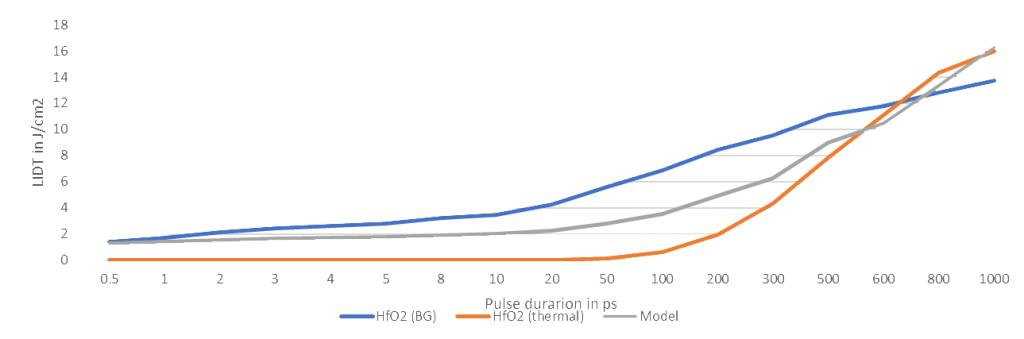
Analysing the previously mentioned coating materials the following formula is found to estimate the LIDT:
LIDT\,[inJ/cm^2] = (\sqrt{(n)} + (t/A)) * t^1 / n^3
In this formula, t is the pulse duration (dimensionless) in ps, n is the refractive index as per the above table and A is an empirical, material specific factor. For each specific material the factor was found to be as follows:
- SiO2: 200
- HfO2: 200
- Ta2O5: 250
- TiO2: 600
- Al2O3: 220
While the above formula allows a reasonable estimate of LIDTs in the ps pulse duration regime it is equally clear from the above that more research is need to get a better understanding of the LIDT. This will have to come from experimental data and specifically from LIDT testing in the 20ps to 500ps regime as such data would allow a much more sophisticated modelling of the LIDT transitional area and a refinement of the above formula, relating it to the imaginary part (i.e. absorption value k) of the coating materials.
ReferenceS and further reading
[1] Ryan J. McGuigan, Helmut Kessler, “Thermal laser induced damage in optical coatings due to an incident pulse train”, Proc. SPIE 11910, Laser-induced Damage in Optical Materials 2021, 1191013 (19 November 2021)
[2]Mero et al (Phys Rev B71, 115109)
[3]P.J.L. Herve, L.K.J. Vandamme, Infrared Phys. 35 (1994) 609
Frequently Asked Questions
Q: What is the primary cause of laser damage in the picosecond regime?
A: The picosecond regime features a changeover between thermal damage and ionisation. Shorter pulses are less likely to fail due to a lack of heat dissipation and are more likely to fail because of material ionisation.
Q: How does this model differ from nanosecond scaling?
A: Nanosecond scaling generally uses a “square root” formula based on thermal mechanisms. This model extends existing nanosecond and femtosecond models to provide a more accurate estimate for picosecond durations.
Q: Which materials are the most susceptible to damage?
A: High-index materials are identified as the weakest link in the coating. The note covers materials such as TiO₂, Ta₂O₅, HfO₂, Al₂O₃, and SiO₂.
Q: What formula is used to estimate the LIDT?
A: The LIDT is estimated using the following material-specific equation: LIDT[inJ/cm²] = (n + (t/A)) * t¹/³ In this formula, t is the dimensionless pulse duration in ps, n is the refractive index, and A is an empirical factor.