

Plasma Mirror Optics for Ultrafast and High-Energy Systems
In high‑energy ultrafast laser systems, amplified spontaneous emission and low‑intensity pre‑pulses can pre‑ionise a target before the arrival of the main pulse. MPO plasma mirrors are engineered to address this challenge through self‑induced plasma shuttering.
At low intensity, the anti‑reflection coated substrate remains effectively transmissive. As the peak intensity reaches the ionisation threshold, electrons are liberated from the surface and an overdense plasma forms at the plasma–vacuum interface. This layer of plasma behaves as a highly reflective mirror for the main pulse.
Because reflection occurs at the plasma surface rather than within a bulk coating:
- Bulk nonlinear effects such as Kerr self‑focusing are avoided.
- Phase‑matching constraints associated with nonlinear crystals do not apply.
- Operation is possible at intensities beyond conventional dielectric mirrors.
For petawatt laser systems and other ultra‑intense platforms, plasma mirror optics can improve temporal contrast by several orders of magnitude, helping ensure well‑defined laser-matter interaction conditions.
Each irradiated location on the substrate surface is permanently modified during use. For this reason, plasma mirrors are operated as single‑use per shot location, with the substrate translated or repositioned to provide multiple usable areas before replacement is required. We engineer each optic around your beam diameter, pulse energy and shot format to maximise usable surface area and ensure consistent performance across experiments.
Key Characteristics
- High laser‑induced damage (LIDT) threshold substrate materials.
- Anti‑reflection coatings optimised for low residual reflectivity.
- Intensity‑dependent reflective behaviour for temporal contrast enhancement.
- Designed for femtosecond and picosecond pulsed laser systems.
- Suitable for multi‑TW and PW peak intensities.
- Controlled fabrication to minimise sub‑surface damage.
- High after‑coating flatness and precision surface quality.
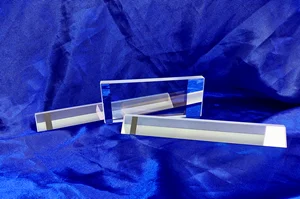
- Optional silver‑coated edge regions for beam alignment.
- Fully customised sizing, materials and coating designs.
- Manufactured, coated and inspected in‑house.
Specifications
Indicative Ranges
- Substrate materials: Fused silica, BK7, others available on request.
- Format: Custom dimensions defined by beam size and translation strategy.
- Surface flatness: Application dependent, high after‑coating flatness available.
- Surface quality: Precision polished substrates.
- Coating: Anti-reflection, optimised for wavelength and required residual reflectivity.
- Wavelength range: Commonly 800 nm (Ti:Sapphire) and 1030-1064 nm (Yb systems); others available.
- Angle of incidence: Defined per system geometry.
- Operation mode: Single-use per surface location with surface translation between shots.
Parameter |
Typical Value |
Notes |
|---|---|---|
Substrate material |
Fused silica/BK7 |
Other materials available |
Coating type |
Anti‑reflection (wavelength specific) |
Residual reflectivity defined per contrast requirement |
Wavelength range |
~800nm/~1030-1064nm |
Other wavelengths available |
Surface quality |
Precision polished |
Application dependent |
Format |
Custom |
Defined by beam diameter and shot pattern |
Alignment option |
Silver‑coated edge regions |
Optional |
Operation mode |
Single‑use per surface location |
Translation between shots recommended |
Specifications shown are indicative of our standard plasma mirror products. If your requirements fall outside these ranges, please contact us to discuss your application.
Applications of Plasma Mirror Optics
Temporal Contrast Enhancement
Plasma mirrors are widely used as temporal contrast enhancement optics in ultrafast laser beamlines. By transmitting low‑intensity background light and reflecting only the high‑intensity main pulse, they help maintain controlled interaction conditions at the target.
Typical applications include:
- Laser-solid interaction experiments.
- Ion acceleration research.
- High-field plasma physics.
- Petawatt‑class and multi-TW laser facilities.
- Ultrafast laser systems operating at 800nm and 1030-1064nm.
Where greater contrast improvement is required, multi‑stage plasma mirror configurations can be implemented.
High‑Order Harmonic Generation and Relativistic Plasma Optics
At relativistic intensities (approximately , wavelength dependent), the plasma surface can oscillate under radiation pressure. In this regime, plasma mirrors can support high‑order harmonic generation in the EUV and soft X‑ray regions, including attosecond pulse structures.
These capabilities make plasma mirror optics valuable components in advanced ultrafast research platforms exploring relativistic laser–plasma interaction.
Environmental and System Integration
Plasma mirror optics are typically integrated within vacuum beamlines alongside high-energy ultrafast laser systems. We can advise on:
- Vacuum-compatible mounting.
- Translation or rotation strategies.
- Debris management considerations.
- Integration with diagnostic and optical assemblies.
Our experience supplying plasma mirror components to major research facilities ensures compatibility with demanding experimental environments.
Quality Assurance and Manufacturing
All MPO optics are designed, processed, coated and tested at our Isle of Man facility. Our ISO9001 accreditation supports strict process control, inspection and metrology throughout manufacture. Each plasma mirror optic is verified to ensure consistent optical and coating performance under high-energy laser operation.
Get in touch
Whether you are specifying plasma mirror optics for a new petawatt laser system or upgrading an existing ultrafast beamline, our team will be pleased to assist. Get in touch to discuss your plasma mirror requirements.
Frequently Asked Questions
What is the main advantage of a roof mirror over a solid roof prism?
The primary advantage is the air-path design, which means the roof mirror is free from the bulk material effects that limit solid prisms, such as group delay dispersion, thermal absorption, and chromatic aberration.
How is a roof mirror different from a corner-cube retroreflector?
A roof mirror provides retroreflection in one dimension (a single plane) and preserves the image parity. A corner-cube provides retroreflection in three dimensions but reverses the image parity.
What is a dihedral angle?
It is the angle between the two reflective surfaces. In a roof mirror, this is manufactured to be 90° with extreme precision, which is what enables it to function as a retror